By Dr David Meridian
@chainofconsciousness
Let me say the unfashionable thing first, because everything else hangs on it: AI is a force multiplier, and the only real constraint on it is you.
For two years the clever take has been to explain why it isn’t good enough. Not as fast as a senior hand, not as careful, not as real. Listen closely and most of those verdicts are wearing a costume. “The tool is weak” is usually “I haven’t learned to aim it yet”, and dismissing the tool costs less than admitting that. So we dismiss the tool.
But a multiplier has no opinion about your worth. It just multiplies. Point it at clear thinking and it makes you formidable. Point it at a vague idea and a glowing sense of urgency, and it will manufacture a magnificent amount of wrong, faster than you can read it, faster than you can call it off. The capability was never the question. The aim was always the question. You are the question.
Which is the good news and the bill in one breath: your ceiling is your own judgement, and judgement, unlike talent, you can actually build.
So the cleanest way I know to show you how this goes right, and how it goes badly, is to put it on a battlefield. So let’s have some fun out there. Mind the friendly fire.
Hand a marksman a bolt-action rifle and the slowness is doing quiet work you never thank it for. Between each shot there is a beat. Time to breathe, to reacquire, to ask the only question that matters on a live range: is that a target, or is that one of mine? The rate of fire was never the limit. The beat was the discipline.
Generative AI is the first tool that removes the beat.
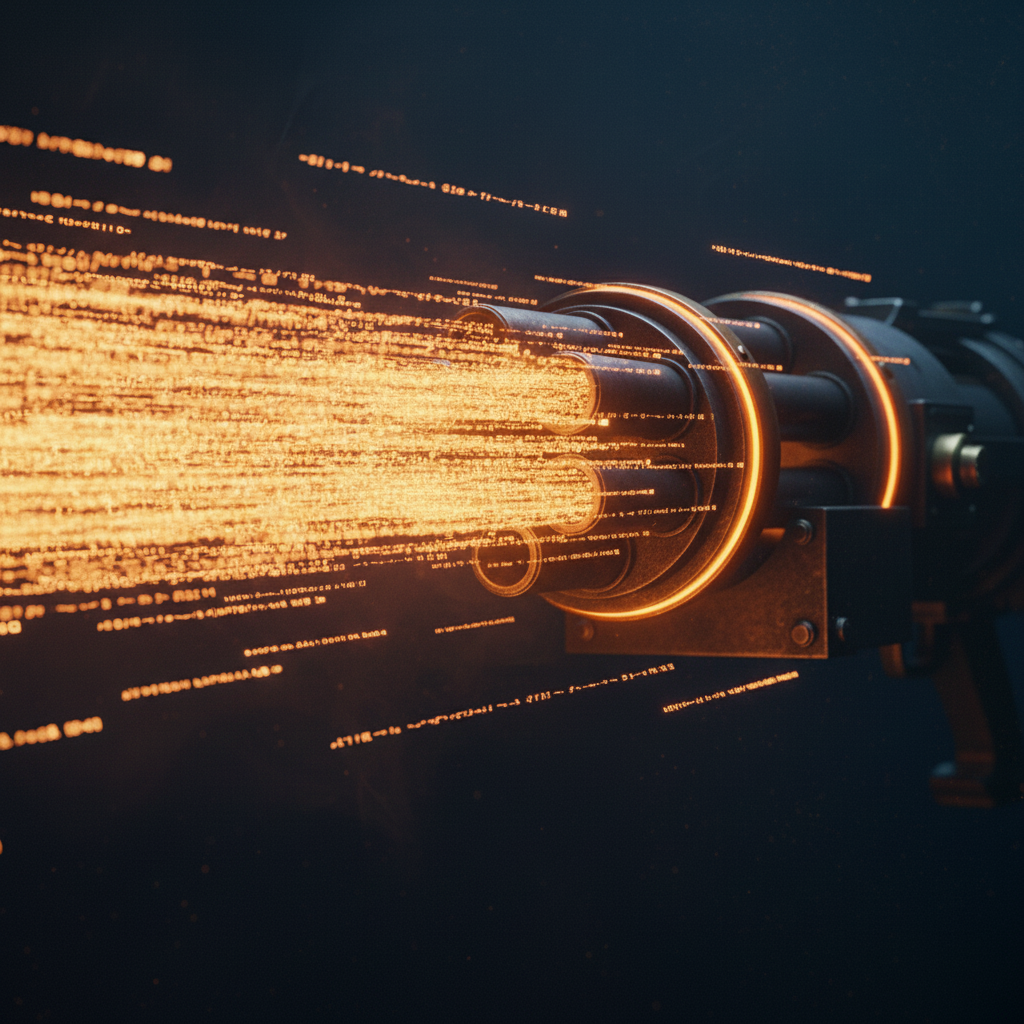
It is a machine gun. It will knock down a thousand valid targets faster than anything before it, and in the wrong hands it will obliterate every friendly agent on the field along the way.
The collateral has a name. It’s drift.
Drift is the wake, not the bug
Every tool before this one was slow enough to keep you honest. Typing speed was your fire discipline. You could not produce faster than you could understand, because your hands set the tempo for both. Intent, artefact, and comprehension moved in lockstep, lashed together by the simple friction of having to type the thing yourself.
AI cuts that lashing. Generation is now cheap; comprehension is not. The two come uncoupled, and the gap between them can open at machine speed while you close it at human speed.
Drift is what lives in that gap. It is not a malfunction. It is the wake the machine leaves when no one is steering, and it is nearly invisible until it is too late.
You were closing in. The barrel kept spinning, kept getting hotter, and you told yourself you had it. I can bring this back under control, just let me take out these last four or five in one sweep. The hits were the proof you were winning. They were also the reason your finger never came off the trigger. And somewhere in that spray, without your ever meaning it, one of your own goes down. Damn. That was Johnny.
We have source control, of course. Most of the time we can roll the mess back and come away in one piece. But sometimes the drift runs too long before anyone calls it, and by the time you look up the field is already strewn with your own.
The four corners
To see drift clearly, hold four things in your head that are supposed to stay aligned:
- What you meant: the intent, the spec.
- What exists: the artefact, the code, the thing now sitting on disk.
- What you understand: your live mental model of that thing.
- What’s true: reality, the ground.
Every species of drift is simply a gap opening between two of these corners. Name the gap and you’ve named the drift.
A field guide
In the artefact:
- Design drift. What exists pulls away from what you meant. The classic. Spec said one thing; the build, edit by edit, became another.
- Architectural drift. Not divergence from the spec, but loss of internal coherence. Each generated change takes the path of least resistance, and patterns quietly multiply. You go looking one day and find four different ways of doing the one thing, none of them decided, all of them accreted.
- Scope drift. Because building is cheap, the spec itself bloats. You add because you can, not because you should. Capability lowers the price of “yes” until the project is fat with features no one needed.
- Documentation drift. The words fall behind the build. Your engineers have a backstop: the code is its own documentation, and a careful reader can recover the truth from the source. Your users have none. For them the manual, the help page, the onboarding is the product. Ship features faster than you write the words around them and the app ends up doing a great deal and explaining almost none of it, with no one left who holds it clearly enough to make it friendly again.
In the operator, the under-discussed half and the dangerous one:
- Cognitive drift. The code outruns your understanding of it. It works, you didn’t write it, you’re not quite sure how, and you ship anyway. Comprehension debt, accruing silently.
- Vigilance drift. The machine is right ninety-five times, so you stop checking on the ninety-sixth, exactly when the rare error is most camouflaged and most expensive. Reliability quietly disarms the guard you most need.
- Discipline drift. The standard erodes. “Let it write the thing, I’ll pay the debt down later.” Later is a country very few people ever visit.
- Taste drift. The output is fluent and plausible, so your own bar recalibrates, from right down to plausible, one acceptable-looking result at a time. Mediocrity normalises.
- Skill drift. You deskill. The muscle to build it, or even to review it, wastes from disuse. This is the one you cannot
git revert.
In the loop, and in the ground:
- Context drift. Over a long session, the machine’s grip on the original goal mutates; summary and compression lose the why, and the next hour of work anchors to a destination that has quietly moved.
- Test-as-mirror drift. The quiet killer. When the machine writes the code and its tests, the tests verify the code’s behaviour, not your intent. Your safety net becomes a mirror. The verifier has been corrupted by the very thing it was meant to check.
- Truth drift. Facts, numbers, citations, all subtly invented or quietly stale. Most vicious inside a knowledge base, where the drifted record gets cited as the source, and the error launders itself into fact.
Rapid Fire Sniper
Here is the part most people have backwards.
For decades the industry quietly rewarded the specialist. The one who knew a single thing all the way down. The regiment’s best shot, the sniper who could put a round through a target at distance better than anyone alive. That was worth rewarding. The mistake was treating it as the whole war.
I knew an engineer who spent thirty years inside one mainframe database. Three decades, one system, and he was very good at it. But look at it from the other side. He was rewarded for owning the last twenty per cent of a single subject, the deep narrow tail of it, while a generalist could learn and carry five times the complexity and knowledge. This has always been the way, and there is no grievance in it. If you want to just snipe, learn to snipe, and don’t complain.
It is simply how the gate worked. When the contract goes out, the man who is ten out of ten at one language and useless at everything else gets it over the man who is nine at that language and nine at thirty other things. The interview only asked about the one. The people asking only knew the one. The gate was real, and it was filtering for the wrong thing.
AI changes the maths, so look at what actually goes into a shot. Whether you can even work out what to aim at. How fast you bring the sights onto it. How far out you can reach. How quickly you swing to the next one. How many rounds a minute you can put down. How often you miss. And how often the thing you hit turns out to be one of your own.
The machine takes almost every one of those and turns it up to the top. Aim, range, retargeting, rate of fire, even your accuracy once the target is named. All of it cheap now, all of it rented by the hour. It leaves two alone, and they are the first and the last on the list. Working out what to aim at. And knowing, before you fire, whether that shape is the enemy or one of yours. Those two were the whole question from the start, and the second of them, hitting your own, is just drift by another name.
So the scarce thing was never the firing. It is whoever can work that first dial, the target, across the most ground. Think about the general. He sees the whole field. He knows which ridge matters, where the engagement turns, how the parts move together. He was never the best radio operator, or the best shot, or the best medic. But he knew enough of each to command them. That is what breadth is: not the best at any one station, but enough at every station to direct the whole.
The most remarkable generals have more than that. They have depth as well, and artistry, and creativity, and an army to carry it out. But a general with no army is just an extremely capable mercenary, reduced to the one thing he can do with his own two hands.
What AI gives him is the army. Not skills he never had, but hands for the judgement he already has. Every station manned at once by the machine, all of it work he knows enough to direct and to check. The breadth that used to cost him depth is suddenly the thing being multiplied. Give the tool to a man strong in one plane and you get that one plane, faster. Give it to the man who can read the whole field and it multiplies across all of it, because he can still aim every round.
Here is the catch the hype skips. The machine multiplies what is already there. It cannot conjure what is not. Give the same tool to a mind that only ever held one plane, and it floods the thirty it never learned, but he cannot command ground he cannot read, so the fire goes unchecked, and that is where the drift pours in. AI gives hands to the man who can already read the field. It cannot give him the eyes. It will turn out all kinds of clever-looking work in the planes he cannot see. It just will not be his, and he will be the last to know. He has turned the gun on himself without ever meaning to.
And this is the new part, the one that was never possible before. A Gatling gun fired like a sniper rifle. You always had to pick one or the other, the single aimed shot or the wall of fire, never both at once. The man who can hold the field, handed this, gets both. A thousand rounds a minute, every one of them landing where he meant it to.
Breadth is not only a technical thing. The creative mind, the one that can see the shape of something before it exists, was always rare on its own. Creativity is worth a lot by itself. So is breadth. But the person who has both is the one this changes most. Creativity decides what is worth building; breadth lets you go and build the whole of it. Put both in one head and you do not just go faster. You multiply.
So marksmanship, depth in the one plane, was never the top of the ladder. It only looked that way while firepower was scarce and our filters could not measure anything else. What sat above it the whole time was breadth: the man who can see the whole field and knows where to point the gun. Give him this kind of firepower and he does the work of the whole unit on his own. The generalist becomes the army.
Holding the line
You do not fight drift by going slower. The infantry already named the disciplined opposite of spray-and-pray: bounding overwatch. One element advances a short bound while another holds and covers; then they swap. Nobody ever outruns their support. You fight drift the same way, by keeping the loop tight enough that no gap can open faster than you can close it:
- Small, reversible diffs. Review at diff-size, not at dump-size. A drift you can catch in seconds never becomes a drift you can’t catch at all.
- A contract and a golden example. Specify the shape of done and hand over one perfect instance before the machine runs. This fixes more than a smarter model ever will.
- Divergence that announces itself. Make the work surface its own assumptions and doubts, so you read a short confession instead of the whole corpus. The drift should raise its own hand.
- Machines guarding the gate. Anything a machine can verify should never reach your scarce human attention unchecked. It validates, it builds, it tests, a second agent cross-checks.
None of these slow the gun. They restore the beat.
The field you can rebuild, and the parts you can’t
Here is the mercy in it: the same machine that strewed the field can walk back across it and rebuild. Refactor, migrate, backfill the tests, pay down the debt, at a scale no human crew could manage. The third act of drift isn’t despair. It’s recovery. But three things stop that recovery going soft:
- Source control brings the soldiers back. It doesn’t bring back the hour you spent killing them. You rebuild the artefact. You rarely recover the comprehension. The mental model that drifted is still drifted after the revert.
- Some casualties don’t respawn. A bug that already reached users. A knowledge base cited while it was wrong, the false report everyone downstream already believed. Your own atrophied skill. Git cannot reach those.
- The repair cadence is the controlled cadence you skipped. Slow, deliberate, covered. Which means the careful pace was always the price of the objective. Drift just lets you pay it twice, the second time backwards, over ground you already bought with blood.
So the moral is not never fire fast. It is that the measured, covered advance you’ll use to repair the field is the same advance you should have made across it. It costs the same, and only one direction leaves no casualties.
The line to leave them with
The machine will give you a thousand targets a minute for as long as you can feed it. It can even make a fair guess at which of those silhouettes is wearing your own colours. It just cannot do it as well as you can, and it never has to live with getting it wrong. That was always the job of the hand on it.
The drift isn’t a flaw in the machine. It’s the wake it leaves when no one is steering, and it stays invisible right up until the moment you count your own dead, because every single round looked like a hit.
David Meridian
Postscript. Everything here has been about one mind and one weapon. Put a few of these people in a room, wired together, and the maths changes again, the breadth shared instead of carried alone. That is the part I find most interesting, and the part I have to be most careful about. For another time.