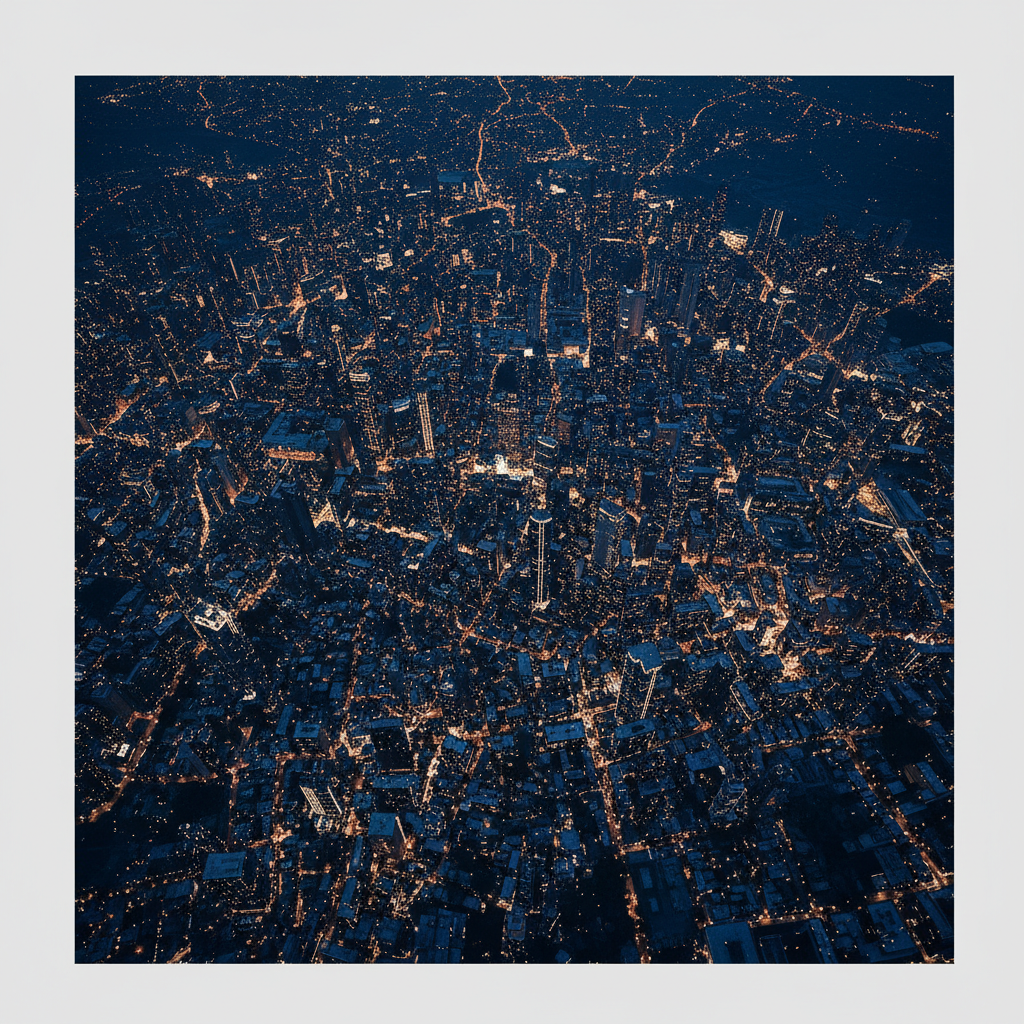
By Dr David Meridian
@chainofconsciousness
Author’s note. Some notes on the current state of AR and world-mapping technology, written from inside WeaponARy Corp’s research office in May 2026. Whether the prototypes I describe were installed eighteen months ago or eighteen years ago, I’ll leave open. Read it as fiction. Hold the parts that feel true.
Personal transcript.
A photograph can show you a street. It cannot tell you what is happening on it right now.
This month Google connected Genie 3 to Street View, and for a week the industry talked as though the map had come alive.1 Two hundred and eighty billion panoramas across one hundred and ten countries: you pick a real place, choose a style, type a character into the box, and the world unfolds around you in real time, playable.
Bilawal Sidhu, one of the few writing publicly who grasps what just happened, called it “the geospatial substrate becoming legible.”1 He is right. After two decades sitting there as a passive reference layer, Street View’s job description changed overnight.
We have been building toward something far more than this for more than a decade at WeaponARy Corp. Genie 3 plus Street View is the world as a photograph that has learned to move; we want a structural mapping of the world brought to light, illuminated, so a new paradigm of ingenuity can be brought to life.
So I am setting some of it down for the record, while the public is finally looking in the right direction. Not all of it.
I. The Gap Google Has Not Closed
Sidhu showed it himself.1 In his Genie demo, he stood behind the Palace of Fine Arts in San Francisco and walked into a row of phantom houses. The real view, of course, is the Marina: water, sailboats, the bay. The substrate had hallucinated. Two hundred and eighty billion panoramas, and the model still guessed wrong about a city it has been driven through ten thousand times.
His prediction: Google will add retrieval next. Pull the freshest panorama as the camera moves. Better photos, more often.
That is still photos.
The real gap is not stale imagery. It is that no panorama, however fresh, can tell you whether the chair has been moved, or whether the door is open today, or whether the child is in the corridor at half past three. Google renders the world as it was last seen. An AR overlay needs the world as it is right now.
You cannot photograph your way out of that. The world has to sense itself, continuously, in place, and report only what has changed.
That is what we built. The walls. Lidar scanning of the entire planet, on the fly, by the planet itself. Set against this, Genie’s clever guesswork from old photographs is DOS-level for the AR layer: admirable for its day, already a generation behind what is quietly running underneath it.
II. The Stack: Where Watchstones Sit
It helps to lay the layers out plainly, because the public conversation tends to argue about whichever one is in the news that week without naming the rest.
| Layer | Name | What it does |
|---|---|---|
| 0 | Satellites | Global imaging from orbit. Maxar, Planet Labs, Sentinel. Daily cadence at best, metres per pixel, no detail below the canopy. The roof of the model. |
| 1 | Personal devices, cameras only | The basic phone in your pocket. Niantic’s VPS, Apple’s Look Around, Google’s AR Core, every photogrammetry app a tourist uses in Florence. RGB photogrammetry, no native depth. User-driven. Ephemeral. Where the wearer goes, the layer goes. Where they don’t, it doesn’t. |
| 1.25 | Personal devices, depth-capable | The next rung up. iPhone Pro and iPad Pro have shipped with LiDAR since 2020. AR-class smart glasses arriving in 2026 are expected to follow, since most premium concepts already include LiDAR or time-of-flight depth sensors to anchor AR content to surfaces. Same ephemerality as L1, but the data is geometry, not just pixels. |
| 1.5 | Vehicle fleets | Waymo, Tesla, robotaxis, last-mile delivery bots. Already-driving sensors mapping the world as a by-product of moving people and parcels around it. Better-than-Street-View geometry along every road they touch. |
| 2 | Crowd-photo plus AI synthesis | Google’s 280 billion Street View panoramas across 110 countries, plus Genie 3 generating playable scenes between them. Sidhu’s substrate. Beautiful, often wrong, photogenic, stale. |
| 2.5 | Dedicated update drones | Purpose-built aerial fleets whose only job is to fly the gaps in the substrate and refresh what has changed. Currently in pilot. They will scale. |
| 3 | Living infrastructure | Watchstones. Sensors built into the bricks, the plaster, the precast panels, the kerbstones. The wall is the device. This is where LuminARy lives. |
| 4 | (reserved) | Deeper still. Mobile sub-surface sensing: nano-crawlers, structural strain meshes, sensing that moves through the fabric rather than living in it. Watchstones are good enough to go live with now. The successor work is, of course, well underway. Layer 4 is a later transmission. |
Layers 0 through 2.5 share a structural problem: they are all external observers of a world that does not, of itself, talk back. Every one of them is a way of pointing a camera at a thing, and is therefore obsolete at the moment of capture, kept fresh only by more capture. You could split this further if you wanted to. There are point clouds living in cloud storage, photogrammetry meshes, VPS overlays, map-data brokers. They all share the same shortcoming.
Layer 3 inverts the problem. The world becomes the observer of itself. The wall reports that a chair has moved within it; the brick a few feet away reports that the door it sits next to has been left open at 14:47 and is still open at 15:02. The kerbstone outside knows when a child has crossed.
The other layers will keep improving, as they should. They will get cheaper, denser, more sophisticated. But none of them will solve what Layer 3 solves, because none of them are in the surfaces. Looking at a surface is not the same as being one.
That is the gap LuminARy occupies.
III. What Emerges: LuminARy
Two named things sit at the centre of this work, with the real world underneath them.
The first is the LuminARy Bridge: between the real world and the virtual one. This illuminates the structure of the real world, so everyone can overlay it with ingenuity. Watchstones are the devices we deploy. Construction and retrofitting plant them (even drones), and a cloud twin holds the result. Together they scan, they map, they store. That whole apparatus, taken as one thing, is the Bridge between now and what we choose to overlay on it in AR.
The second is LuminARy itself: what emerges on the other side of the Bridge. Once a city’s worth of Watchstones is in place and the Bridge is running, the real world is no longer mute, and the potential is staggering.
We did not choose the name carelessly. A luminary, in the older sense, is a body that gives off light: the sun, the moon, the stars. In the modern sense it is a person who shows the way. We meant both. We tucked the AR inside the word in the hope that the unARverse would forgive us the pun.
A Watchstone is a small lattice-grown semiconductor unit about the size of a fingernail. It is embedded directly into the fabric of a building, not stuck onto a surface or bolted to one. The wall itself becomes the device.
There are two installation paths. The slow one is new-build: the stone goes into the brick at the kiln, into the plaster as it cures, into the precast concrete panel before the panel leaves the yard. Done at scale, every new development becomes Watchstone-native from completion.
The fast one is the drive tool: a handheld unit, roughly the weight of a nail gun, that drills the cavity and plants the stone in a single trigger pull. The stone reads the surface as it seats (texture, dielectric, material class) and matches its lattice to what it has been planted into. It is scanning before the operator’s finger has lifted off the trigger. You can retrofit a Victorian terrace block in a weekend. Replacement uses the same trigger pull as installation. The slower property-development cycle does not apply, because the building does not have to change; the wall only has to receive one.
For public-realm infrastructure (roads, bridges, kerbs, lampposts, tunnel walls) the drive tool rides a drone. The same airframes that the industry has been proposing as Layer 2.5 scanners become, in our hands, the airframes that seed Layer 3. A drone does not need to fly over a road again and again to update a map. It needs to fly it once, drop the substrate, and let the road update itself thereafter.
Once installed, a Watchstone rarely needs touching. A failed one is swapped out with the drive tool, not repaired in place. It powers itself off a hybrid. The conventional harvesters do the day-to-day work: vibration, ambient radio frequency, indoor light, the kinetic nudges of doors opening and feet passing on the floor it shares a substrate with. Underneath that sits a Casimir-class quantum baseline that keeps the lattice ticking at idle when the conventional sources go quiet. Same family of physics as the recent public work in the area, reached from a different direction, running in our walls for years. The lattice surface sheds dust and biofilm under its own micro-vibrations, so it cleans itself. And the visible face is a chameleon e-ink layer that reads the surrounding material on installation and re-tunes its colour, grain, and tone to disappear into it. A Watchstone in red Victorian brick looks like red Victorian brick; a Watchstone in Portland stone looks like Portland stone. You will not see one unless you know where to look, and even then you will probably not see it. They can be told to show themselves, of course; under maintenance, under operator command, under whatever protocol calls for it, a Watchstone can illuminate its face for a moment, declare itself, and vanish back into the wall. It runs a chip-scale lidar about ten times a minute and reports only what has changed since the last report. The world updates itself by exception.
Cats’ eyes for 2030, and for the next century after that, since the bricks they live in are not going anywhere.
The public alternative is to send up more vehicles. More drones, more Street View cars, more satellite passes, more fleets in the sky burning fuel to scan a planet that, with a small change of habit, can simply scan itself. Why ask a drone to look at a wall when the wall can tell you what it sees?
The point of all of it is LuminARy: a persistent illuminated layer that is anchored to the world, not floating beside it. Every wearable approach to AR has the same shortcoming. When the wearer takes the gear off, the layer is gone with them; when they walk into a building the layer has not been installed in, there is no layer to walk into. LuminARy has to live where people live, in the streets and the rooms and the bricks themselves.
This is a long-game proposition. We are not racing the consumer-electronics cycle. We are building something the next century reads from.
IV. On Privacy, and What We Will Not Pretend
The objection writes itself. A LuminARy lattice at ten thousand or more nodes per square mile is, on the face of it, the most ambitious sensing instrument ever proposed. I would think the same in your position. I want to answer it directly, and not from behind a marketing line.
Three things, in order.
First, the planet is already awash with tracking. Every phone in every pocket reports its position dozens of times an hour. Every car built since 2020 is a moving telemetry node. Every smart-city camera, every doorbell, every payment terminal, every cellular triangulation, every advertising-ID broker. We did not build any of that, and we did not need to. The Watchstone lattice does not introduce surveillance; it joins a chorus that has been singing for fifteen years.
Second, a lattice this dense cannot ship without a privacy layer baked into the protocol itself. Ours does. Every Watchstone supports an anonymisation mode that strips identity from movement and retains only the geometry of what has changed. The wall knows a chair has moved. It does not know who moved it. That is the default the system ships in. To run a Watchstone in identified-tracking mode requires an explicit operator override and a cryptographic key the Corp does not hand out lightly.
Third, governments will sometimes decide to disable the default. We expect that, and it is not within our gift to prevent. What we can do is force transparency. When a Watchstone is operating in identified-tracking mode, the lattice broadcasts that fact, in real time, to anything within range. Your glasses or your phone will tell you, within seconds of you entering the square, whether the Watchstones around you are anonymous-by-default or identified-by-policy. You then decide whether to stay in that square. The state can track you. The state cannot track you secretly.
It is not a perfect answer. An enthusiastic operator will find ways around any protocol we publish, and the line between public space and private space has always been negotiated rather than settled. What WeaponARy Corp will not do is build a planet-scale sensing layer and pretend the privacy question never came up. The Corp builds the latest tech. It also has a core of genuineness, which means asking the harder question first.
V. The People Whose Names Belong on This Work
The components of a Watchstone exist in the open literature, and the people who put them there should be named.
Kris Pister at Berkeley imagined “smart dust” in 1997, when the industry was still building servers the size of refrigerators.2 He was thirty years early and entirely correct.
Zhong Lin Wang invented the triboelectric nanogenerator.3 Every footstep on a floor a Watchstone shares is its lunch. That, along with our own variant of the quantum-baseline work Sonny White is now describing publicly, is the reason a Watchstone does not need a battery.
Ali Hajimiri at Caltech shrank lidar to the head of a pin using nanophotonic phased arrays.4 Without his work, the Watchstone has no eye.
These three define the public stack. The internal route at WeaponARy Corp differs in several respects we do not discuss. It is good to see the public stack arriving where we have been quietly working for over a decade. The conversation outside is finally interesting enough to be worth having.
VI. A Note on Sonny White
This month Dr Harold “Sonny” White at Casimir, Inc., formerly of NASA Eagleworks and the warp-drive programme, announced MicroSparc.5 A five-millimetre chip claiming roughly forty microwatts drawn from the quantum vacuum, via Casimir cavities engineered as one-way electron ratchets. Hundreds of prototypes already fabricated at Texas A&M’s AggieFab and MIT.nano. Commercialisation targeted for 2028. Backed by Kam Ghaffarian of Intuitive Machines and Axiom Space. The wider physics community, when asked to comment, mostly declined.
This is the kind of public work that makes the field more interesting. White himself notes that the physics is not new; the Casimir effect has been quantum-mechanics canon since the mid-twentieth century. The questions are about engineering and manufacturing maturity. We agree.
What our Watchstones run on, I described earlier: conventional harvesting over a Casimir-class quantum baseline. That baseline is the same family of physics as MicroSparc, reached from a different direction. It has been running in our walls for years.
White’s cavity-and-ratchet engineering is a clean piece of work. It is narrower than our hybrid, but elegant on its own terms, and ours has the advantage of already being in the walls. If MicroSparc scales, I would fold it in without much ceremony: fewer harvesters, smaller die, longer life. Good to see Casimir harvesting move from fringe to serious public conversation.
This is the relationship I try to keep with public state-of-the-art: glad it exists, watching it carefully, getting on with the work that needs doing.
VII. The Eyes Are Arriving
The substrate is only half of it. Something has to read what the walls report and paint it back for a person to see. That is what the glasses are for, and the glasses are finally arriving.
Google Glasses are back, a decade after the Explorer flameout, this time as a real product line under Android XR.6 Two versions ship this autumn: audio glasses that talk to you, and display glasses that overlay what you see. They go on sale through Warby Parker, in frames you might wear to dinner. The thing everyone laughed at in 2013 is now ordinary eyewear. That is not a small change.
Sergey Brin’s Project Aura is the louder signal.7 When a founder re-enters a category he once walked away from, you can take it as read that the hard problem has become tractable.
But a pair of glasses can only see what the wearer is looking at. Walk into a room and they map it; turn around and they lose what was in front of you to find what is behind. That is how a wearer-mounted sensor has to work. It sees what it sees, when it sees it.
It cannot tell you about the street you have not yet walked into, the bollard between you and the corner you are about to round, the chair you are about to charge past at full tilt in a game, the child in the doorway you have not yet glanced at. The wearer’s layer is real but bounded: a torch beam, sweeping. Watchstones are the room with the light on.
The eyes are arriving. The walls have been listening for ten years.
VIII. The Point of All of This
WeaponARy Corp is a defence and commercial company. I will not pretend otherwise, and LuminARy will carry that work: commerce, defence, instruction, logistics, a hundred operations that get easier once the world can read itself back. That is real, and it is most of the business case.
But it is not the part I find interesting. So let me tell you about one of the fun ones instead.
The same layer that routes a convoy or prices a shop floor can be turned the other way, toward the people living on it. That is the part that matters to me: LuminARy can illuminate the world to help people, not degrade it.
Here is what I mean. When LuminARy is dense enough, when the bricks of a city are a million quiet sensors and the glasses have arrived to see what they show, the same street can become a game board: anywhere, for anyone who walks into it. A child’s quest, a commuter’s route, an old person’s memorial walk, all layered on the one pavement, none of them interfering, all of them anchored to the real thing rather than painted on after the fact.
That is what I hope WeaponARy Corp is remembered for. Not a curated dream you log into, but the real street you are standing on, with the chair that has just been moved and the door that is open today because the cat got out.
If the Hollowing is the disease, this is the start of the answer. VR was retreat: the world swapped out for a friendlier copy. LuminARy is the opposite. It does not replace the world. It lights up the one we already have.
Percy Shaw watched a cat in the headlights on a foggy Halifax road in 1934 and invented the reflective road stud. Small lights, showing the way home through the fog. LuminARy is the same instinct on a different scale: light the world, so people can find their way through it and build things on it no one has imagined yet.
That is Layer N. That is LuminARy. The Watchstones have been in the walls for years. When the glasses arrive this autumn, the world will already know what to show them.
David Meridian
Systems Intelligence, WeaponARy Corp
[End Transmission 002]
Editor’s note from the present
This is the second transmission in the Chain of Consciousness archive, and the first set in the present rather than a remembered future. The Hollowing was the warning. LuminARy and the Watchstones is where the answer starts.
The Corp’s habit, for over a decade, has been to build rather than publish. This transmission is the unusual exit from that habit. Read accordingly.
The real-world references in this piece (Bilawal Sidhu’s reading of Genie 3 plus Street View, Sonny White’s MicroSparc at Casimir Inc., the Pister / Wang / Hajimiri lineage, Google’s Android XR Glasses relaunch, Sergey Brin’s Project Aura) are all live as of May 2026. Where the piece overshoots into territory WeaponARy Corp has not publicly confirmed, that is the in-universe frame doing its work. Or it isn’t. Readers may decide.
Forthcoming transmissions:
- Mapping the Living Surface: the layer model in depth, from Google’s panoramas to crowd-sourced LiDAR to the substrate beneath.
- The blockchain ledger of contribution and consent: Layer N for governance.
- The drive tool and the drone fleet: how a Watchstone gets into a wall, anywhere, in seconds.
— Dr David Meridian
Systems Intelligence, WeaponARy Corp
@chainofconsciousness
References
Sidhu, Bilawal. “Google Just Turned Street View Into a Video Game.” Map the World by Bilawal Sidhu (Substack), 21 May 2026. https://www.spatialintelligence.ai/p/google-just-turned-street-view-into ↩︎ ↩︎ ↩︎
Pister, Kris S. J. Smart Dust: Autonomous Sensing and Communication in a Cubic Millimeter. UC Berkeley, 1997–. Project page: https://people.eecs.berkeley.edu/~pister/SmartDust/ ↩︎
Wang, Zhong Lin. Triboelectric Nanogenerators (TENG). Georgia Institute of Technology / Beijing Institute of Nanoenergy and Nanosystems. Overview: https://en.wikipedia.org/wiki/Triboelectric_nanogenerator ↩︎
Hajimiri, Ali. Caltech Holistic Integrated Circuits Lab — nanophotonic phased-array on-chip lidar. https://chic.caltech.edu/ ↩︎
Plain, Christopher. “Free Energy from the Vacuum? Warp Drive Pioneer Unveils Battery-Free ‘MicroSparc’ That Allegedly Draws Power from the Quantum Vacuum.” The Debrief, 12 May 2026. https://thedebrief.org/free-energy-from-the-vacuum-warp-drive-pioneer-unveils-battery-free-microsparc-that-allegedly-draws-power-from-the-quantum-vacuum/ ↩︎
Google. “Google I/O 2026: All our announcements.” Google Blog, 2026. Android XR audio and display glasses shipping autumn 2026 in partnership with Gentle Monster, Warby Parker, and Samsung. https://blog.google/innovation-and-ai/technology/ai/google-io-2026-all-our-announcements/ ↩︎
Brin, Sergey. Project Aura, Google’s founder-led AR-glasses initiative positioned as the premium tier within the Android XR ecosystem. Coverage through 2025–2026 in The Verge, Bloomberg, and 9to5Google. ↩︎